The gap between what children from low- and high-socioeconomic families access outside of school is not new. What is new and urgent is that the funding systems designed to help close that gap are now under direct threat.
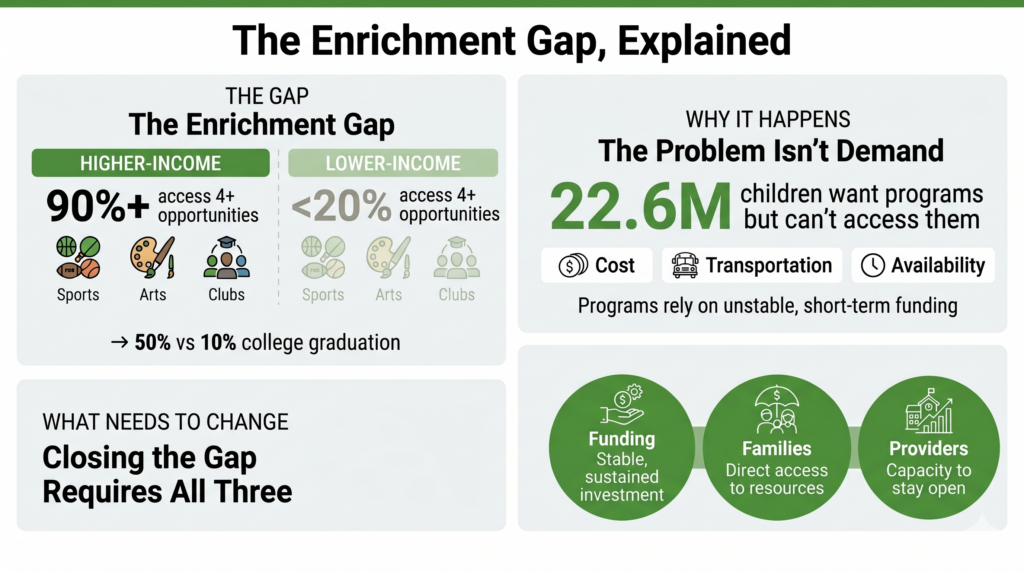
A 26-year longitudinal study tracking 814 children from birth through age 26 found that when children from low-income households went from zero to four enrichment opportunities, such as sports, arts programs, clubs, and meaningful after-school activities, their odds of graduating college increased from 10 to 50 percent. Their annual earnings by age 26 rose by roughly $10,000 (Source: Hechinger Report). By the end of high school, more than 90 percent of higher-income children had experienced four or more such opportunities, compared to fewer than 20 percent of lower-income children.
This is the enrichment gap. It is not a supplement to the education system. It is one of the most powerful predictors of long-term outcomes we have. And right now, the systems that support access to these opportunities are becoming less stable, not more.
Summer Is Where the Gap Becomes Visible
When school-based supports disappear, access to learning depends almost entirely on whether families can find, afford, and reach out-of-school programs. For many families, those options do not exist or are not accessible. This is when the enrichment gap widens fastest.
The barriers are not just financial. Families must navigate a fragmented system of programs, determine what is available, and find options that are geographically accessible. Even when programs exist, transportation and system complexity often prevent participation.
Summer is not just a break from school. It is a stress test of whether the system can deliver access at all.
A System Built for Fragmentation, Not Access
According to the Afterschool Alliance’s 2025 America After 3PM report, 22.6 million children want to participate in out-of-school programs, but are unable to due to barriers including cost, transportation, and lack of access to programs. (Source: Afterschool Alliance)
This gap has persisted despite decades of public investment intended to expand access. The 21st Century Community Learning Centers program, first authorized in 1994 and significantly expanded in 1998 and the early 2000s, was designed to provide after-school and summer learning opportunities for students in underserved communities. It remains the largest dedicated federal funding stream for out-of-school time, currently supporting 1.4 million children nationwide.
Even with this investment, access gaps have remained. Now, the proposed elimination of $1.33 billion in 21st Century Community Learning Centers funding would remove that federal support entirely, at the same time that Colorado has reduced its own state-level investment in out-of-school time. This makes 2026 a critical decision point for whether access expands or contracts. (Source: Afterschool Alliance)
This is not just a funding shortfall. It is a system design failure.
Out-of-school programs are expected to meet growing demand while relying on fragmented, short-term funding streams that were never designed to provide consistent access. Multiple funding sources operate independently, with no cohesive structure to ensure stability for providers or reliability for families.
Organizations piece together grants, philanthropy, and earned revenue year to year without the predictability needed to plan staffing, maintain capacity, or expand. When a single funding source disappears, programs shrink or close. When programs close, families lose access. This pattern disproportionately impacts those with the fewest alternatives.
Some states have begun to address this by establishing dedicated funding streams for out-of-school time, creating more predictable access for families and stability for providers. Colorado does not yet have a comparable system.
What Funding Failure Looks Like on the Ground
Across Colorado, providers are working to meet consistent demand for summer and after-school programming while navigating unstable funding. Organizations like Boys & Girls Clubs serve hundreds of young people across large geographic areas, offering academic support, enrichment, and safe spaces outside of school hours. Demand remains high, particularly during the summer months when school is not in session.
What is inconsistent is the system’s ability to sustain these programs year to year. Funding gaps limit capacity, reduce program availability, and create uncertainty for both providers and families.
What RESCHOOL’s Model Can and Cannot Solve
RESCHOOL’s Learning Dollars put funding directly in families’ hands to pay for the out-of-school learning that matters to them, including tutoring, arts programs, camps, and cultural experiences. This directly addresses affordability, one of the primary barriers to access.
But affordability is only one part of the system.
Direct-to-family funding addresses cost and gives families the ability to choose and prioritize the learning experiences that matter most to them. It reflects demand more accurately by putting resources in the hands of those navigating the system directly.
It does not solve provider sustainability or system fragmentation. If providers cannot afford to remain open, access disappears regardless of whether families have funding. And in communities where programs are already limited, affordability alone does not create supply.
The National Academies of Sciences has emphasized that youth development depends on consistent access to high-quality, relationship-based experiences across settings, not just isolated opportunities (Source: National Academies of Sciences). That level of consistency requires infrastructure that the current system does not provide.
What Needs to Change
If current funding patterns hold, access will continue to shrink even as demand from families remains high and increasingly visible. Addressing the enrichment gap requires structural changes that account for how supply, demand, and system infrastructure interact.
Three priorities are clear:
1. Sustained, dedicated funding streams for out-of-school time: Reduce reliance on fragmented, short-term funding that leaves providers unable to plan or scale. Without this, programs will continue operating in survival mode.
2. Direct-to-family funding mechanisms: Ensure families can access and choose learning experiences that align with their children’s needs. These mechanisms address affordability and surface real demand. Without them, cost remains a barrier, and systems lack visibility into what families actually need.
3. Investment in provider capacity: Ensure that community-based organizations can meet demand through stable staffing, programming, and operations. Without this, funding flows into a shrinking supply of programs.
What Comes Next
RESCHOOL is not just making the case for these changes. We are testing what works.
Our Learning Dollars model, provider-facing investments, Learner Advocate network, and broader ecosystem-building efforts are generating real-world evidence about what it takes to expand access in practice.
The evidence already exists. The risk is not that we do not know what to do. It is that funding decisions continue to ignore what is already working.
If you are a funder, policymaker, provider, or intermediary working on out-of-school learning, we invite you to stay connected and to be part of this conversation.
You can follow our latest blogs and updates on our website and sign up for RESCHOOL’s newsletter to receive future pieces like this in your inbox: [Subscribe to RESCHOOL’s newsletter]