Tag

education funding

May 12, 2026

The Enrichment Gap Is a Funding Problem We Haven’t Solved

The enrichment gap is widening as funding for out-of-school learning becomes more unstable. RESCHOOL examines why access depends on funding systems and what it will take to create consistent opportunities for families.

The enrichment gap is widening as funding for out-of-school learning becomes more unstable. RESCHOOL examines why access depends on funding systems and what it will take to create consistent opportunities for families.

The gap between what children from low- and high-socioeconomic families access outside of school is not new. What is new and urgent is that the funding systems designed to help close that gap are now under direct threat.

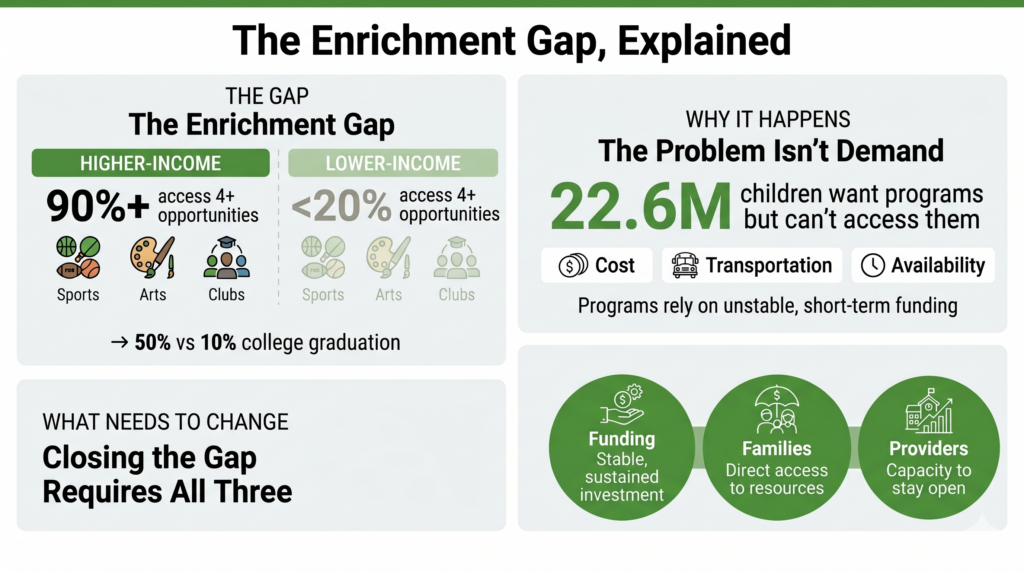
A 26-year longitudinal study tracking 814 children from birth through age 26 found that when children from low-income households went from zero to four enrichment opportunities, such as sports, arts programs, clubs, and meaningful after-school activities, their odds of graduating college increased from 10 to 50 percent. Their annual earnings by age 26 rose by roughly $10,000 (Source: Hechinger Report). By the end of high school, more than 90 percent of higher-income children had experienced four or more such opportunities, compared to fewer than 20 percent of lower-income children.

This is the enrichment gap. It is not a supplement to the education system. It is one of the most powerful predictors of long-term outcomes we have. And right now, the systems that support access to these opportunities are becoming less stable, not more.
Summer Is Where the Gap Becomes Visible

When school-based supports disappear, access to learning depends almost entirely on whether families can find, afford, and reach out-of-school programs. For many families, those options do not exist or are not accessible. This is when the enrichment gap widens fastest.

The barriers are not just financial. Families must navigate a fragmented system of programs, determine what is available, and find options that are geographically accessible. Even when programs exist, transportation and system complexity often prevent participation.

Summer is not just a break from school. It is a stress test of whether the system can deliver access at all.

A System Built for Fragmentation, Not Access

According to the Afterschool Alliance’s 2025 America After 3PM report, 22.6 million children want to participate in out-of-school programs, but are unable to due to barriers including cost, transportation, and lack of access to programs. (Source: Afterschool Alliance)

This gap has persisted despite decades of public investment intended to expand access. The 21st Century Community Learning Centers program, first authorized in 1994 and significantly expanded in 1998 and the early 2000s, was designed to provide after-school and summer learning opportunities for students in underserved communities. It remains the largest dedicated federal funding stream for out-of-school time, currently supporting 1.4 million children nationwide.

Even with this investment, access gaps have remained. Now, the proposed elimination of $1.33 billion in 21st Century Community Learning Centers funding would remove that federal support entirely, at the same time that Colorado has reduced its own state-level investment in out-of-school time. This makes 2026 a critical decision point for whether access expands or contracts. (Source: Afterschool Alliance)

This is not just a funding shortfall. It is a system design failure.

Out-of-school programs are expected to meet growing demand while relying on fragmented, short-term funding streams that were never designed to provide consistent access. Multiple funding sources operate independently, with no cohesive structure to ensure stability for providers or reliability for families.

Organizations piece together grants, philanthropy, and earned revenue year to year without the predictability needed to plan staffing, maintain capacity, or expand. When a single funding source disappears, programs shrink or close. When programs close, families lose access. This pattern disproportionately impacts those with the fewest alternatives.

Some states have begun to address this by establishing dedicated funding streams for out-of-school time, creating more predictable access for families and stability for providers. Colorado does not yet have a comparable system.

What Funding Failure Looks Like on the Ground

Across Colorado, providers are working to meet consistent demand for summer and after-school programming while navigating unstable funding. Organizations like Boys & Girls Clubs serve hundreds of young people across large geographic areas, offering academic support, enrichment, and safe spaces outside of school hours. Demand remains high, particularly during the summer months when school is not in session.

What is inconsistent is the system’s ability to sustain these programs year to year. Funding gaps limit capacity, reduce program availability, and create uncertainty for both providers and families.

What RESCHOOL’s Model Can and Cannot Solve

RESCHOOL’s Learning Dollars put funding directly in families’ hands to pay for the out-of-school learning that matters to them, including tutoring, arts programs, camps, and cultural experiences. This directly addresses affordability, one of the primary barriers to access.

But affordability is only one part of the system.

Direct-to-family funding addresses cost and gives families the ability to choose and prioritize the learning experiences that matter most to them. It reflects demand more accurately by putting resources in the hands of those navigating the system directly.

It does not solve provider sustainability or system fragmentation. If providers cannot afford to remain open, access disappears regardless of whether families have funding. And in communities where programs are already limited, affordability alone does not create supply.

The National Academies of Sciences has emphasized that youth development depends on consistent access to high-quality, relationship-based experiences across settings, not just isolated opportunities (Source: National Academies of Sciences). That level of consistency requires infrastructure that the current system does not provide.

What Needs to Change

If current funding patterns hold, access will continue to shrink even as demand from families remains high and increasingly visible. Addressing the enrichment gap requires structural changes that account for how supply, demand, and system infrastructure interact.

Three priorities are clear:

1. Sustained, dedicated funding streams for out-of-school time: Reduce reliance on fragmented, short-term funding that leaves providers unable to plan or scale. Without this, programs will continue operating in survival mode.

2. Direct-to-family funding mechanisms: Ensure families can access and choose learning experiences that align with their children’s needs. These mechanisms address affordability and surface real demand. Without them, cost remains a barrier, and systems lack visibility into what families actually need.

3. Investment in provider capacity: Ensure that community-based organizations can meet demand through stable staffing, programming, and operations. Without this, funding flows into a shrinking supply of programs.

What Comes Next

RESCHOOL is not just making the case for these changes. We are testing what works.

Our Learning Dollars model, provider-facing investments, Learner Advocate network, and broader ecosystem-building efforts are generating real-world evidence about what it takes to expand access in practice.

The evidence already exists. The risk is not that we do not know what to do. It is that funding decisions continue to ignore what is already working.

If you are a funder, policymaker, provider, or intermediary working on out-of-school learning, we invite you to stay connected and to be part of this conversation.

You can follow our latest blogs and updates on our website and sign up for RESCHOOL’s newsletter to receive future pieces like this in your inbox: [Subscribe to RESCHOOL’s newsletter]
February 18, 2026

Expanding Opportunities for Youth: Why Out-of-School Time is the Future of Learning

Young people spend most of their waking hours outside of school, yet funding for out-of-school time remains scarce and unstable. RESCHOOL Colorado shares what it is learning from Learning Dollars, Pick-a-Passes, and community pilots in Jefferson County and beyond, and offers design principles for public funding that actually reaches families.

Young people spend most of their waking hours outside of school, yet funding for out-of-school time remains scarce and unstable. RESCHOOL Colorado shares what it is learning from Learning Dollars, Pick-a-Passes, and community pilots in Jefferson County and beyond, and offers design principles for public funding that actually reaches families.

Expanding opportunities for youth beyond school

Young people spend roughly 80% of their waking hours outside of school. These hours are where passions are discovered, identities are shaped, relationships are built, and safe spaces matter most. Yet out-of-school time (OST) funding remains scarce and increasingly unstable. Recent federal and local cuts are shrinking options for families, straining providers, and widening access gaps. At a time when young people need strong community ecosystems, we believe those ecosystems must be strengthened, not allowed to erode.

Sustaining equitable access to OST requires a multi-pronged funding strategy; no single source can meet the scale of demand. RESCHOOL is advancing both system-level and local solutions, collaborating with providers and advocacy partners to protect existing public funding while also leveraging new opportunities, including the federal Education Freedom Tax Credit. With Colorado now opting in, this policy has the potential to unlock new resources for schools, districts, and out-of-school providers and to expand direct-to-family funding beginning in 2027.

At the same time, we continue investing directly in families and communities. Through Pick-a-Passes, families receive year-long access to cultural institutions and state parks that might otherwise be out of reach. Through Learning Dollars, families receive direct funding to choose learning experiences aligned with their children’s interests and needs. Together, these strategies strengthen the broader ecosystem while ensuring families have meaningful options today.

What we’re learning from Learning Dollars and Pick-a-Passes in Colorado

In 2025, RESCHOOL:

  • Reached 100+ youth and families with Learning Dollars and Pick-a-Passes
  • Supported eight learning providers to expand programming in communities where families in our network live
  • Resourced two community-based partners to serve as learner advocates, helping families navigate access to funding
  • Expanded access across Denver, Jefferson County, Thornton, and Commerce City

One place where this work came to life in 2025 was Jefferson County.

In 2025, RESCHOOL partnered with community organizations in Jefferson County to pilot a privately funded Learning Dollars program. The goal was straightforward: give families flexible resources and support so their children could access high-quality learning experiences beyond school.

A few things defined this approach:

  • Funds went directly to families and out-of-school providers.

Families received Learning Dollars they could use for programs that fit their child, like sports, arts, tutoring, outdoor programs, cultural experiences, and more. Community-based out-of-school providers also received funding to expand or adapt offerings for families in RESCHOOL’s network.

  • Choice was guided, not scripted.

Instead of prescribing a narrow list of programs, families had the freedom to use their funds in ways that furthered their children’t interests and needs. To the extent families needed support accessing options, we focused on helping them identify what mattered most – schedule, transportation, cultural fit, their child’s interests – and then match those priorities with actual options.

  • Community partners were at the center.

Local providers, schools, and community organizations helped shape the design and outreach. They weren’t just “vendors,” they were co-designers and trusted messengers.

The JeffCo fund was one of three funds that RESCHOOL ran last year. Across these three funds, RESCHOOL raised $125,000 in philanthropic funding to expand opportunities for youth in various communities in and around Denver in 2025:

These dollars translated into concrete opportunities: sports leagues, summer and after-school programs, arts and outdoor experiences, and access to museums and cultural institutions. Families repeatedly told us it was one of the first times a system felt designed around what they needed, instead of asking them to squeeze into a narrow set of options.

Across those funds, the core pattern is the same: When dollars are flexible, paired with navigation support, and rooted in community relationships, they reach the kids they’re supposed to reach.

Why This Matters Now: A New Federal Tax Credit 

This work is happening as the new federal Education Freedom Tax Credit moves toward implementation, with Colorado among the states opting in. The program is designed to offer tax credits for contributions that can be used for both private school choice and enrichment/out-of-school learning for public school students.

The federal tax credit, expected to go live in early 2027, will allow Colorado to:

  • Attract new investment in our education system from individual donors 
  • Fill persistent funding gaps, including for out-of-school learning 
  • Provide a steady funding source to resource school districts and OST providers interested in participating in the program
  • Align philanthropic dollars with Colorado’s education, workforce, and student success priorities

RESCHOOL will be working hard with our partners and the state to ensure that the rollout of this program reflects what we’ve learned over the years working in partnership with communities, that it is designed in such a way that it reaches all families – especially those who face greater barriers to access, and that it gives families genuine agency in how to use the dollars they receive.

Design Principles For Public Funding That Actually Reaches Families

Based on what we’ve learned and what broader OST research confirms, a few design principles stand out. These are questions every public funding model, including tax credits and other choice programs, should be able to answer.

1. Start with what families say they need

Too many programs start with a funding mechanism and work backwards. Direct-to-family models flip that script. Public programs should build in listening and co-design with families who face the greatest barriers, use tools like the Family Choice Journal to surface priorities like safety, culture, logistics, and interests, and share information in clear, multilingual formats. If a funding model is hard to understand or navigate, it will quietly exclude the families it is supposed to serve.

2. Pair dollars with navigation and relationship-based support

Money alone is not enough when systems are complex. Our pilots show that trusted navigators and community-based staff are critical in helping families understand what funds can be used for, compare options, and solve for barriers like transportation, forms, or digital access. Public programs should treat navigation as a core cost, not an optional add-on, or benefits will skew toward families who already have time, information, and networks.

3. Fund a whole ecosystem, not just single programs

Families use Learning Dollars for sports, arts, tutoring, outdoor experiences, cultural institutions, and workforce-connected opportunities. That diversity is a strength. Public funding should recognize community-based organizations and cultural institutions as essential parts of the learning ecosystem, make it feasible for smaller organizations to participate, and invest in tools like the Denver Learning Ecosystem so families and partners can see what exists and where gaps remain. If we want young people to have a rich mix of experiences, we have to fund the ecosystem that makes those experiences possible.

4. Treat pilots as R&D for public systems

Pilots should be understood as research and development, not side projects. The core questions are: What did we learn about how funds were used? Who did we reach, and who did we miss? What would it take to move from a privately funded pilot to a sustainable, equitable public program? Keeping those questions at the center helps ensure innovation is tied to equity and scale, rather than happening on the margins.

What Comes Next

In 2026, RESCHOOL will keep using private funds to test models that show what’s possible when families are truly in the driver’s seat. At the same time, we’ll be working with partners to explore how future public funding, including the federal tax credit and related state policies, can be designed in ways that:

  • Direct resources to families and community providers
  • Build navigation and ecosystem infrastructure, not just isolated programs
  • Close, rather than widen, existing gaps in access and opportunity

If you’re a funder, policymaker, provider, or intermediary thinking about the future of out-of-school learning in Colorado, we’d like to be in conversation with you.

To follow along and get future pieces like this in your inbox, sign up for RESCHOOL’s email updates and keep an eye on our blog as we continue to unpack what we’re learning: [Subscribe to RESCHOOL’s newsletter]