Families rarely experience learning one program at a time. This blog explores how families build learning ecosystems through relationships, trust, community, and everyday life, and why systems should be designed with those realities in mind.
What RESCHOOL is learning about the real-life ecosystems that support young people.
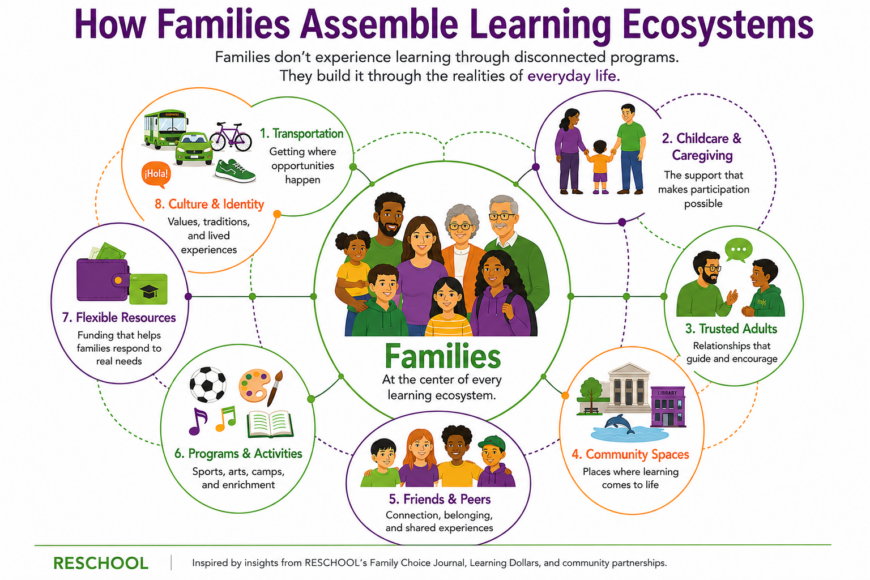
For many of us, the phrase “learning opportunities” brings to mind specific programs: summer camps, afterschool activities, tutoring sessions, internships, classes, or school-based enrichment. But families rarely experience learning one program at a time. They navigate work schedules, transportation, childcare, family responsibilities, neighborhood relationships, children’s interests, cultural identity, safety, cost, and trust. They do not simply choose from a menu of programs. They assemble learning around real life.
Across RESCHOOL’s work with families, one pattern continues to emerge: learning beyond the classroom is not separate from the everyday systems families rely on. It happens through relationships, routines, community spaces, trusted adults, shared responsibilities, and opportunities that help young people feel curious, capable, connected, and known.
If we want to build stronger learning ecosystems, we need to understand that families sit at the intersection of the relationships, resources, and realities that make learning possible.

Families Organize Life Around People, Not Programs
Education systems often organize learning into categories: school, afterschool, summer, enrichment, childcare, tutoring, transportation, and family engagement. These categories help institutions plan and fund services. But they do not necessarily reflect how families experience learning.
For families, a single decision about an out-of-school activity may involve many practical and personal questions at once. Is it close enough to home, school, or a relative’s house? Can siblings attend together? Is the schedule realistic? Is transportation possible? Will my child feel safe? Will the adults understand my child’s needs? Does the program affirm my child’s identity? Is there help with equipment, uniforms, or supplies? Will this experience help my child build confidence, make friends, or discover something new?
RESCHOOL’s Family Choice Journal was designed around this reality. Rather than asking families to select a program from a list, it begins by helping young people and families reflect on their values, hopes, needs, and priorities. Families consider what they hope their child will gain from a school or activity, from learning something new and building curiosity to feeling a sense of belonging, making friends, connecting with supportive adults, and preparing for what’s next. They also weigh practical considerations such as transportation, schedules, safety, cost, accommodations, equipment and supplies, and opportunities for continued involvement and growth.
This is a much fuller picture of learning choice than the one systems often use. It recognizes that families are not only evaluating whether an activity sounds enriching. They are evaluating whether it fits into the actual conditions of their lives. In other words, while systems tend to bundle learning into programs and institutions, families often assemble it through the realities of everyday life.
Families Build Learning Through Relationships, Trust, And Community Infrastructure
RESCHOOL’s work in the Globeville, Elyria, Swansea community offers a concrete example of what this looks like. In 2025, RESCHOOL supported families in G.E.S. through Learning Dollars, Pick-a-Pass programs, and Provider Dollar Grants. The report describes G.E.S. as a culturally diverse neighborhood with multilingual households, multigenerational families, strong family ties, and a history of community activism. It also notes that the neighborhood has been shaped by physical isolation, fragmented infrastructure, environmental conditions, limited walkable green space, and economic barriers that limit access to youth opportunities.
In that context, out-of-school learning is not simply about whether a program exists. It is about whether families can realistically use it, whether they trust it, and whether it reflects what they want for their children.
The collaboration with Cultivando is instructive. RESCHOOL and Cultivando have partnered for more than five years to support families with resources and learning experiences, including Learning Dollars, cultural institution memberships, and customized activity booklets that help families navigate their children’s learning. Cultivando’s Promotora Model, built around trained local leaders who serve as bridges between families and resources, matters because trust and navigation are part of the learning infrastructure.
The G.E.S. report shows that when families received flexible supports, they made intentional decisions. Through Pick-a-Pass, 20 families received year-long memberships to cultural institutions. The most popular choice was the Denver Aquarium. Families cited cost, educational value, nature and outdoor experiences, family time, and children’s preferences as reasons for choosing particular memberships. One parent explained that they did not want to have to choose between taking their children out and paying rent. Another described choosing the Museum of Nature and Science because there was a lot to learn and explore as a family, including history, origins, ancestors, and culture.
The point is not just that families accessed a museum or aquarium. These memberships became part of family life. They allowed families to return multiple times, explore together, include all family members, access spaces they had not visited before, and build shared experiences. The report notes that Pick-a-Pass memberships became more than individual family opportunities. Because many families selected the same institution, they also created a shared experience and helped build a sense of community.
Families weren’t simply accessing opportunities individually. Their choices created informal networks of shared experience, where children encountered one another outside of school, and cultural spaces became places of connection. In some cases, families also coordinated care and supported one another’s participation, reinforcing that the infrastructure of learning often includes the informal networks families build to help one another navigate daily life.
Learning Dollars revealed a similar pattern. Families used funds for learning materials, art and music supplies, computer skills, sports, educational toys, camp, and even driving lessons. One parent used Learning Dollars for driving lessons to help their son build confidence and motivation. Another used the funds for camp and camp clothing, as they were necessary for participation. These examples illustrate that some of the investments families prioritize may not look like “education” in a traditional sense. Yet they are deeply connected to how young people grow, participate, and experience the world around them.
Provider Dollar Grants extended this ecosystem further by supporting community-centered programming developed with family needs in mind. In G.E.S., grants supported a strength, conditioning, and mindfulness summer program and a music and literacy program designed by community-based educators working closely with participating families. These experiences helped young people build confidence, strengthen social connections, and engage positively in structured activities that reflected their interests and needs.
This is what family-centered learning ecosystems look like in practice. They are not built only through programs. They are built through trusted partners, flexible resources, local educators, cultural spaces, transportation realities, shared family priorities, and opportunities that respond to what young people and families say they need. In other words, families don’t experience learning as a collection of disconnected services. They experience it as part of the ongoing work of raising children, caring for one another, and building community.
What If Systems Started With Family Reality?
The stories and decisions emerging from the Family Choice Journal and the G.E.S. partnership point to a simple but important observation: families experience learning through the realities of everyday life, while systems often organize it into separate categories and disconnected services. Families don’t distinguish between transportation, childcare, enrichment, relationships, and learning in the same way institutions do. They are constantly weaving these pieces together, making decisions based on what is practical, meaningful, and possible for their children. In many ways, families are doing the work of building coherence across systems that were never designed to fit neatly together.
That reality places an enormous amount of invisible labor on families. Parents and caregivers become schedulers, transportation coordinators, information seekers, advocates, and opportunity brokers. They figure out which experiences align with their children’s interests, who can help with pickups, whether costs can be managed, and which environments feel safe and welcoming. The examples from G.E.S. illustrate that this work is not simply logistical. It is deeply relational. Families rely on trusted community members, exchange recommendations, learn from one another, and create informal networks of support that help opportunities become accessible and meaningful.
What RESCHOOL continues to learn is that supporting young people means paying attention to the conditions that shape family decision-making in the first place. These observations are consistent with national findings. According to the Afterschool Alliance’s 2026 America After 3PM Summer Report, parents prioritize experiences that provide safety, caring and knowledgeable adults, opportunities to build confidence, time with peers, physical activity, and opportunities for children to spend less time on screens and more time engaged with others. These priorities reflect a broad understanding of what helps young people thrive and closely mirror what families in G.E.S. prioritized through their own choices. Flexible funding matters. Trusted relationships matter. Community partnerships matter. But perhaps most importantly, families need systems that recognize the realities they are already navigating rather than expecting them to adapt to rigid structures that overlook the complexity of everyday life. The future of learning ecosystems may depend less on creating entirely new programs and more on designing with family reality at the center.
How Families Make Learning Work
Families have always been building learning beyond the classroom. They do it when they coordinate rides to activities, seek out trusted adults, revisit museums and community spaces, share recommendations with other parents, and make difficult decisions about how to invest limited time and resources in the experiences they believe will help their children thrive. Much of this work happens quietly and often goes unseen, but it is no less essential to young people’s growth and development.
If we want to build stronger learning ecosystems, we have to pay attention not only to the programs we create, but also to the realities families navigate every day. The stories emerging from the Family Choice Journal, the G.E.S. partnership, and communities across Colorado remind us that families are not passive recipients of opportunity. They are active participants in shaping it, assembling experiences through relationships, routines, trust, and care.
At RESCHOOL, that means continuing to learn alongside families, not simply designing for them. Because the future of learning may depend less on asking families to adapt to systems that were never built with them in mind, and more on building systems that recognize what families have been showing us all along: learning doesn’t happen separately from everyday life. It happens through it.
The families featured in this work remind us that learning doesn’t happen in isolation. It happens through relationships, community, and the everyday decisions that shape young people’s lives. We invite educators, providers, policymakers, funders, and community leaders to continue learning alongside families and to consider what it would look like to design with family reality at the center.
To stay connected with RESCHOOL’s latest insights and stories from the field, subscribe to our newsletter and follow our work at: [Subscribe to RESCHOOL’s newsletter]