Tag

learning ecosystems

March 16, 2026

Who Helps Families Navigate Learning When Choices Expand?

As education choices expand, families need more than options, they need guidance. RESCHOOL Colorado explores why navigation and learner advocacy matter, and how trusted adults can help families connect school, out-of-school learning, and real-world opportunities into a more coherent path.

As education choices expand, families need more than options, they need guidance. RESCHOOL Colorado explores why navigation and learner advocacy matter, and how trusted adults can help families connect school, out-of-school learning, and real-world opportunities into a more coherent path.

Across the country, families are hearing a familiar message: more education choices are coming.

Education savings accounts, tax credits, scholarships, work-based learning, early college, and expanded out-of-school programs. On paper, it looks like a wider set of opportunities for young people. In practice, it often looks like a more fragmented system that asks families to do even more work to find, evaluate, and piece together options.

That is the paradox at the heart of today’s education landscape. Choice is expanding, while the structure and accountability that families can rely on are thinning out. Many families now have more responsibility for navigating learning, but fewer supports to do it.

RESCHOOL sees this shift very clearly in Colorado. For more than a decade, we have worked alongside families, community organizations, and systems leaders to understand how young people actually experience learning across their days, years, and communities. What we hear again and again is simple:

Families do not just need more options. They need someone in their corner to help make sense of those options.

This is where navigation and learner advocacy come in.

From More Options To More Complexity

Two big shifts are happening at the same time.

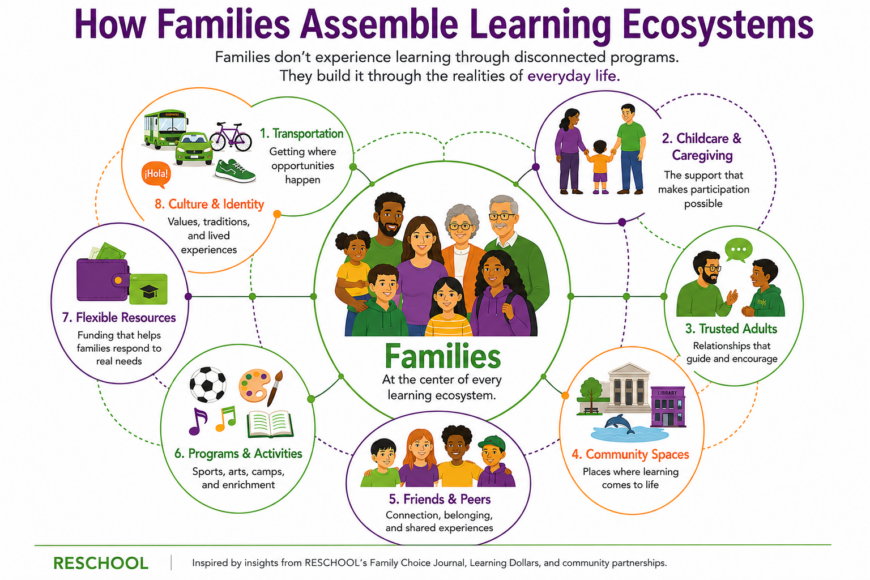
First, learning is decentralizing. Young people spend roughly 80 percent of their waking hours outside of school. Those hours are filled, in very uneven ways, with sports, jobs, caregiving, community programs, cultural activities, and online experiences. New public and private funding tools are starting to acknowledge that learning happens across this wider ecosystem, not only inside school buildings.

Second, accountability is changing. Traditional systems often relied on a fairly rigid structure: one primary school, one set of tests, one district that holds most of the formal responsibility. In some new choice and tax credit programs, that structure is loosening or disappearing without something else in its place. Families are asked to make complex decisions, track learning, and coordinate schedules across multiple settings, often with little support.

Parents tell us they are excited about new possibilities, but they are also overwhelmed. They want to know:

  • Which options are a good fit for my child, not just in theory but in real life with our schedule, transportation, and responsibilities?
  • Who will help us connect school, out-of-school programs, and work-based learning so it adds up to something coherent?
  • If something goes wrong, who is responsible for fixing it?

These questions are not technical details; they are the daily reality for families trying to help their children thrive in a landscape that is changing faster than the support and governance structures around it.

What We Mean By “Learner Advocacy”

In this context, RESCHOOL has been exploring what it would look like to create a learner advocate network that can serve as a steady anchor for young people and their families.

A learner advocate is a trusted adult or team whose primary responsibility is to the learner, not to a single program or institution. That person or team:

  • Helps connect what happens in school, out-of-school time, and real-world experiences so it counts and builds toward something larger
  • Helps families understand the full range of learning options available to them
  • Supports them in making choices that reflect their values, goals, and constraints
  • Stays with the learner over time, checking in as needs and circumstances change.

This is not about replacing schools, counselors, or community organizations. It is about stitching together the work that many people are already doing and creating a clear point of accountability for the learner’s overall experience.

In a more dispersed system, where funding and learning are intertwined across multiple settings, someone needs to hold the full picture with the learner at the center. That is the role we see for learner advocates.

What Navigation Looks Like On The Ground

Navigation is easiest to understand in practice. In our work, learner advocacy has included things like:

  • Sitting with families as they use tools such as the Family Choice Journal to identify what matters most to them, including safety, culture, logistics, interests, and relationships
  • Walking them through application and scholarship processes for out-of-school programs, sports, tutoring, and cultural experiences
  • Helping them stack different opportunities so transportation and schedule work across school, after-school, and weekends
  • Connecting families to new programs that match their priorities, not just the most visible or best-funded options
  • Staying in touch over time, especially when a family’s work schedule changes, a young person’s interests shift, or a program closes

Families consistently describe how different it feels to have someone actively help them navigate, rather than simply sending a list of links or brochures.

For young people, navigation and advocacy can also show up as:

  • A trusted adult who asks about their interests and future plans, and then points them to programs, jobs, or courses that align with those interests
  • Someone who helps connect a job or internship to graduation requirements, industry credentials, or college credit
  • An advocate who notices when a student is overextended or under-supported, and helps adjust their mix of commitments
  • A guide who helps families and youth navigate system barriers such as language access, technology literacy, transportation, and access to supplies or equipment needed to fully participate

In short, navigation is not a static directory. It is a relationship-centered practice that helps families and youth move through a complex system without having to hold every detail on their own.

Why Navigation Matters Now

The need for navigation and learner advocacy is not new. Families have always relied on informal networks, individual teachers, and community leaders to help them find and access opportunities. What is new is the speed and scale of policy change.

With the federal Education Freedom Tax Credit moving toward implementation, and states like Colorado planning to participate, the number of possible programs, providers, and funding streams will likely grow. If that growth is not paired with navigation and learner advocacy, the benefits will tilt toward families who already have time, information, and connections.

In that scenario:

  • Families with flexible jobs and social networks will be more likely to hear about options, understand eligibility, and successfully apply
  • Families who speak languages other than English, work multiple jobs, or are less connected to formal systems will face higher barriers to participation
  • Out-of-school providers that already have development staff and administrative capacity will be better positioned to tap into new funding streams, while smaller community organizations struggle to keep up

Navigation and learner advocacy do not fix these inequities on their own. They do, however, make it more likely that new dollars reach the families and providers who have historically been left out, rather than simply layering more complexity on top of existing gaps.

How This Connects To Reschool’s Work In Colorado

RESCHOOL’s navigation and learner advocacy work is rooted in Colorado communities. Over the past decade, we have:

  • Supported funds that direct resources to families and providers for out-of-school learning
  • Invested in tools like the Denver Learning Ecosystem website to make opportunities more visible
  • Provided direct learner advocate support to working parents as an employee benefit
  • Worked alongside community partners who act as trusted navigators for families in their neighborhoods
  • Developed and tested resources such as the Family Choice Journal that help families reflect on their priorities and choices

Across these efforts, the throughline is clear. When families have both resources and navigation support, they can access experiences that match their children’s interests and needs. When out-of-school providers have stable, predictable funding and are included in program design, they can expand and sustain offerings that communities rely on. When someone is paying attention to how all of the pieces fit together for the learner, the system feels less like a maze and more like a network of possibilities. And when students can articulate what they have learned and how they have grown across these experiences, it can open doors to future opportunities in school, work, and beyond.

As new public funding tools come online, RESCHOOL will continue to share what we are learning with partners in Colorado and beyond. We see navigation and learner advocacy as essential parts of any serious effort to build and fund equitable learning ecosystems, not as optional extras.

Looking Ahead

Education systems are changing. The question is whether those changes will deepen or narrow access to meaningful learning for young people.

If we want more than a patchwork of programs, if we want ecosystems where all youth can discover their interests, build skills, and feel a sense of belonging, then navigation and learner advocacy have to be part of the design. Families should not be asked to carry the full weight of a more complex system on their own.

In the months ahead, RESCHOOL will be:

  • Continuing to resource navigation and advocacy models with community partners
  • Highlighting tools that support families as they make choices, including the Family Choice Journal
  • Sharing lessons from Colorado with policymakers, funders, and practitioners who are shaping new programs

If you are a funder, policymaker, provider, or intermediary working on out-of-school learning, we invite you to stay connected and to be part of this conversation.

You can follow our latest blogs and updates on our website and sign up for RESCHOOL’s newsletter to receive future pieces like this in your inbox: [Subscribe to RESCHOOL’s newsletter]

February 18, 2026

Expanding Opportunities for Youth: Why Out-of-School Time is the Future of Learning

Young people spend most of their waking hours outside of school, yet funding for out-of-school time remains scarce and unstable. RESCHOOL Colorado shares what it is learning from Learning Dollars, Pick-a-Passes, and community pilots in Jefferson County and beyond, and offers design principles for public funding that actually reaches families.

Young people spend most of their waking hours outside of school, yet funding for out-of-school time remains scarce and unstable. RESCHOOL Colorado shares what it is learning from Learning Dollars, Pick-a-Passes, and community pilots in Jefferson County and beyond, and offers design principles for public funding that actually reaches families.

Expanding opportunities for youth beyond school

Young people spend roughly 80% of their waking hours outside of school. These hours are where passions are discovered, identities are shaped, relationships are built, and safe spaces matter most. Yet out-of-school time (OST) funding remains scarce and increasingly unstable. Recent federal and local cuts are shrinking options for families, straining providers, and widening access gaps. At a time when young people need strong community ecosystems, we believe those ecosystems must be strengthened, not allowed to erode.

Sustaining equitable access to OST requires a multi-pronged funding strategy; no single source can meet the scale of demand. RESCHOOL is advancing both system-level and local solutions, collaborating with providers and advocacy partners to protect existing public funding while also leveraging new opportunities, including the federal Education Freedom Tax Credit. With Colorado now opting in, this policy has the potential to unlock new resources for schools, districts, and out-of-school providers and to expand direct-to-family funding beginning in 2027.

At the same time, we continue investing directly in families and communities. Through Pick-a-Passes, families receive year-long access to cultural institutions and state parks that might otherwise be out of reach. Through Learning Dollars, families receive direct funding to choose learning experiences aligned with their children’s interests and needs. Together, these strategies strengthen the broader ecosystem while ensuring families have meaningful options today.

What we’re learning from Learning Dollars and Pick-a-Passes in Colorado

In 2025, RESCHOOL:

  • Reached 100+ youth and families with Learning Dollars and Pick-a-Passes
  • Supported eight learning providers to expand programming in communities where families in our network live
  • Resourced two community-based partners to serve as learner advocates, helping families navigate access to funding
  • Expanded access across Denver, Jefferson County, Thornton, and Commerce City

One place where this work came to life in 2025 was Jefferson County.

In 2025, RESCHOOL partnered with community organizations in Jefferson County to pilot a privately funded Learning Dollars program. The goal was straightforward: give families flexible resources and support so their children could access high-quality learning experiences beyond school.

A few things defined this approach:

  • Funds went directly to families and out-of-school providers.

Families received Learning Dollars they could use for programs that fit their child, like sports, arts, tutoring, outdoor programs, cultural experiences, and more. Community-based out-of-school providers also received funding to expand or adapt offerings for families in RESCHOOL’s network.

  • Choice was guided, not scripted.

Instead of prescribing a narrow list of programs, families had the freedom to use their funds in ways that furthered their children’t interests and needs. To the extent families needed support accessing options, we focused on helping them identify what mattered most – schedule, transportation, cultural fit, their child’s interests – and then match those priorities with actual options.

  • Community partners were at the center.

Local providers, schools, and community organizations helped shape the design and outreach. They weren’t just “vendors,” they were co-designers and trusted messengers.

The JeffCo fund was one of three funds that RESCHOOL ran last year. Across these three funds, RESCHOOL raised $125,000 in philanthropic funding to expand opportunities for youth in various communities in and around Denver in 2025:

These dollars translated into concrete opportunities: sports leagues, summer and after-school programs, arts and outdoor experiences, and access to museums and cultural institutions. Families repeatedly told us it was one of the first times a system felt designed around what they needed, instead of asking them to squeeze into a narrow set of options.

Across those funds, the core pattern is the same: When dollars are flexible, paired with navigation support, and rooted in community relationships, they reach the kids they’re supposed to reach.

Why This Matters Now: A New Federal Tax Credit 

This work is happening as the new federal Education Freedom Tax Credit moves toward implementation, with Colorado among the states opting in. The program is designed to offer tax credits for contributions that can be used for both private school choice and enrichment/out-of-school learning for public school students.

The federal tax credit, expected to go live in early 2027, will allow Colorado to:

  • Attract new investment in our education system from individual donors 
  • Fill persistent funding gaps, including for out-of-school learning 
  • Provide a steady funding source to resource school districts and OST providers interested in participating in the program
  • Align philanthropic dollars with Colorado’s education, workforce, and student success priorities

RESCHOOL will be working hard with our partners and the state to ensure that the rollout of this program reflects what we’ve learned over the years working in partnership with communities, that it is designed in such a way that it reaches all families – especially those who face greater barriers to access, and that it gives families genuine agency in how to use the dollars they receive.

Design Principles For Public Funding That Actually Reaches Families

Based on what we’ve learned and what broader OST research confirms, a few design principles stand out. These are questions every public funding model, including tax credits and other choice programs, should be able to answer.

1. Start with what families say they need

Too many programs start with a funding mechanism and work backwards. Direct-to-family models flip that script. Public programs should build in listening and co-design with families who face the greatest barriers, use tools like the Family Choice Journal to surface priorities like safety, culture, logistics, and interests, and share information in clear, multilingual formats. If a funding model is hard to understand or navigate, it will quietly exclude the families it is supposed to serve.

2. Pair dollars with navigation and relationship-based support

Money alone is not enough when systems are complex. Our pilots show that trusted navigators and community-based staff are critical in helping families understand what funds can be used for, compare options, and solve for barriers like transportation, forms, or digital access. Public programs should treat navigation as a core cost, not an optional add-on, or benefits will skew toward families who already have time, information, and networks.

3. Fund a whole ecosystem, not just single programs

Families use Learning Dollars for sports, arts, tutoring, outdoor experiences, cultural institutions, and workforce-connected opportunities. That diversity is a strength. Public funding should recognize community-based organizations and cultural institutions as essential parts of the learning ecosystem, make it feasible for smaller organizations to participate, and invest in tools like the Denver Learning Ecosystem so families and partners can see what exists and where gaps remain. If we want young people to have a rich mix of experiences, we have to fund the ecosystem that makes those experiences possible.

4. Treat pilots as R&D for public systems

Pilots should be understood as research and development, not side projects. The core questions are: What did we learn about how funds were used? Who did we reach, and who did we miss? What would it take to move from a privately funded pilot to a sustainable, equitable public program? Keeping those questions at the center helps ensure innovation is tied to equity and scale, rather than happening on the margins.

What Comes Next

In 2026, RESCHOOL will keep using private funds to test models that show what’s possible when families are truly in the driver’s seat. At the same time, we’ll be working with partners to explore how future public funding, including the federal tax credit and related state policies, can be designed in ways that:

  • Direct resources to families and community providers
  • Build navigation and ecosystem infrastructure, not just isolated programs
  • Close, rather than widen, existing gaps in access and opportunity

If you’re a funder, policymaker, provider, or intermediary thinking about the future of out-of-school learning in Colorado, we’d like to be in conversation with you.

To follow along and get future pieces like this in your inbox, sign up for RESCHOOL’s email updates and keep an eye on our blog as we continue to unpack what we’re learning: [Subscribe to RESCHOOL’s newsletter]

January 29, 2026

From Programs to Ecosystems: How RESCHOOL Is Expanding Learning Opportunities in Colorado

RESCHOOL Colorado reflects on more than a decade of work to move from programs to learning ecosystems: directing dollars to families and providers, mapping opportunities, and building the infrastructure that makes out-of-school learning possible for more young people in Colorado.

RESCHOOL Colorado reflects on more than a decade of work to move from programs to learning ecosystems: directing dollars to families and providers, mapping opportunities, and building the infrastructure that makes out-of-school learning possible for more young people in Colorado.

Over the last thirteen years, RESCHOOL Colorado has been asking a simple but disruptive question:

What would it take for young people to learn everywhere, not just in school, and for families to have real power in shaping that learning?

Our 2025 Impact Report compiles some of our efforts to date in answering that question: directing dollars to families and community-based providers, developing tools that make learning opportunities more visible, and partnering with families to define what “good” looks like in a truly learner-centered ecosystem.  

As we move into 2026, we’re deepening that work with a clearer focus on the infrastructure it takes to make expanded learning possible and sustainable. Below, you can read through a few of the key lessons that are shaping that focus.

When Dollars Follow Families And Providers, You See The System Differently

Much of RESCHOOL’s work has centered on a basic shift: move resources closer to the people and places where learning actually happens.

Through Learning Dollars, Provider Dollars, and Learner Advocates, we’ve directed more than $1 million into Colorado communities since 2013, in partnership with over 50 organizations and 15,000 youth and families. These funds have supported tutoring, summer camps, arts and cultural programs, sports, STEM experiences, and more.

Here are a few patterns that have become clear:

  • Families use flexible dollars to fill the “in-between” spaces of learning: after school, weekends, and summers, where enrichment is often out of reach without additional support.
  • Community-based providers use modest, targeted funding to expand or stabilize programs that are deeply rooted in local culture and relationships.
  • Learner Advocates help families navigate options, build trust, and connect dollars to opportunities in ways that match each child’s interests and needs.

This work has reinforced a simple insight: equity is not only about creating more programs; it is about who controls resources, who can actually access them, and who has support along the way.

Mapping And Listening Make An “Invisible” Ecosystem Visible

Another thread in our work has focused on making out-of-school learning ecosystems easier to see and understand.

Tools like the Denver Learning Ecosystem site start to answer basic questions for families and partners: Where are the opportunities? Who are they for? How do you get in the door?  

At the same time, our Invest in Families briefs, co-authored with Outschool.org, uplift what families say they need from funding mechanisms and support systems: clearer information, help navigating options, and more flexible, dignified ways to access learning that fits their lives.  

Taken together, this work points to two related truths:

  • Information matters. If families cannot easily see and compare opportunities, the ecosystem effectively doesn’t exist for them.
  • Navigation matters. When systems are complex or fragmented, families with the most time, money, and social capital can piece things together; others are left behind.

Mapping and listening do not solve those challenges on their own, but they give communities, funders, and policymakers a clearer picture of where the ecosystem is working and where it is not.

Out-Of-School Learning Needs Real Infrastructure, Not Just More Programs

As we’ve reflected with partners on what it actually takes to build equitable learning ecosystems, a pattern has emerged: we are not just talking about more programs. We are talking about infrastructure.

Drawing on RESCHOOL’s experience in Colorado and emerging field conversations, we see at least six components that matter for out-of-school learning infrastructure:

  1. Human infrastructure: Families need people they trust to help make sense of options, funding, logistics, and fit. Learner Advocates and similar roles act as navigators who sit with families, ask good questions, and help remove barriers.
  2. Information infrastructure: Communities need tools that keep information about opportunities current, localized, and easy to use. Mapping platforms and communication tools can bring providers into view and give families timely, language-accessible information.
  3. Transportation infrastructure: Even the best program is irrelevant if a young person cannot physically get there. Transportation stipends, transit passes, mobile programming, and other community-designed solutions are essential for many families.
  4. Financial infrastructure: Mechanisms like Learning Dollars and other direct-to-family funds put resources in families’ hands and allow them to choose what fits. Design details matter here: how funds are accessed, what they can be used for, and how easy they are to navigate all shape who benefits.
  5. Credentialing infrastructure: If out-of-school experiences never show up in transcripts, applications, or credentials, their value is easier for systems to ignore. Communities need ways to document and recognize real-world learning so that skills and experiences travel with young people into future education and work.
  6. Capacity infrastructure: Many of the most meaningful learning experiences happen in small, community-rooted organizations that are under-resourced. Funding, common frameworks, and professional learning can help these providers connect to larger systems without losing what makes them unique.

When these pieces are missing or underdeveloped, even well-designed programs struggle to reach the young people who could benefit most. When they are present, expanded learning ecosystems become more accessible, resilient, and fair.

How These Lessons Are Shaping Reschool’s 2026 Focus

These threads are not separate. They are shaping how we think about RESCHOOL’s role and priorities in 2026:

  • Policy and systems change: Our direct work with families, providers, and navigators gives us grounded insight into how public funding mechanisms could better support out-of-school learning. As conversations about tax credits, ESAs, and other family-directed funds evolve, we are focused on sharing what we’ve learned about design choices that advance equity rather than deepen gaps.
  • High school and postsecondary pathways: Mapping Real World Learning is helping older youth name, document, and build on the skills they gain in jobs, internships, and community programs. This connects directly to credentialing infrastructure and to questions about how systems recognize learning that happens outside of school.
  • Out-of-school time infrastructure: We are continuing to learn alongside families and partners about how human, information, transportation, financial, credentialing, and capacity infrastructure show up in different communities, and what it takes to strengthen them over time.
  • RESCHOOL as a lab and learning partner: We see RESCHOOL’s role as both builder and listener: testing models with families and providers, documenting what we learn, and sharing that learning with funders, policymakers, and other communities who are working on similar questions.

For now, the core insight is simple: if we want learning to happen everywhere, we have to build the infrastructure that makes that possible for every young person, not just a lucky few.

If you’d like to follow along as this work evolves, you can sign up for RESCHOOL’s email newsletter here: [Subscribe to RESCHOOL’s newsletter]