
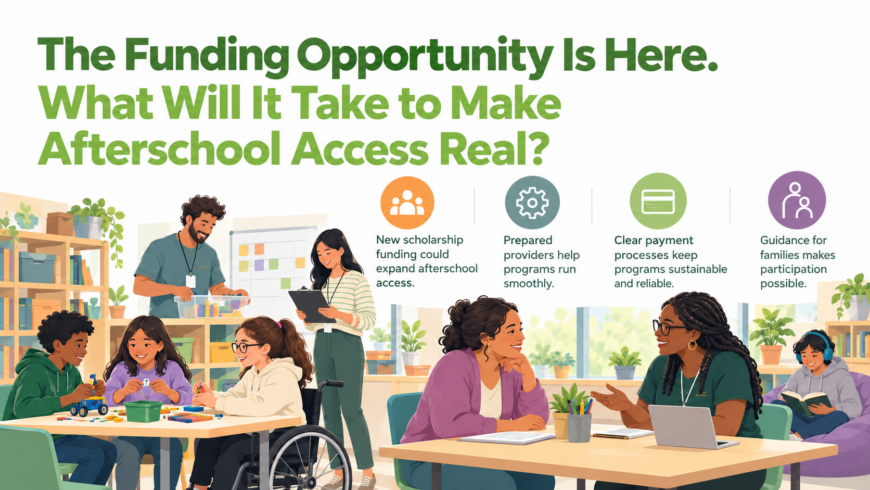
New Colorado afterschool funding could help families participate, but providers also need clear rules, workable payments, and capacity. RESCHOOL explores what it takes to connect scholarship opportunities with dependable learning access, drawing on its experience supporting families and community organizations.
Parents of more than 347,000 Colorado children who are not enrolled in afterschool programs say they would enroll their child if a program were available, according to the Afterschool Alliance’s 2026 Colorado fact sheet. A new funding opportunity could help address that unmet demand: beginning in 2027, a new Federal Scholarship Tax Credit will encourage donations to nonprofit organizations that award scholarships for eligible K–12 education expenses. Further guidance will determine which afterschool and summer programs qualify.
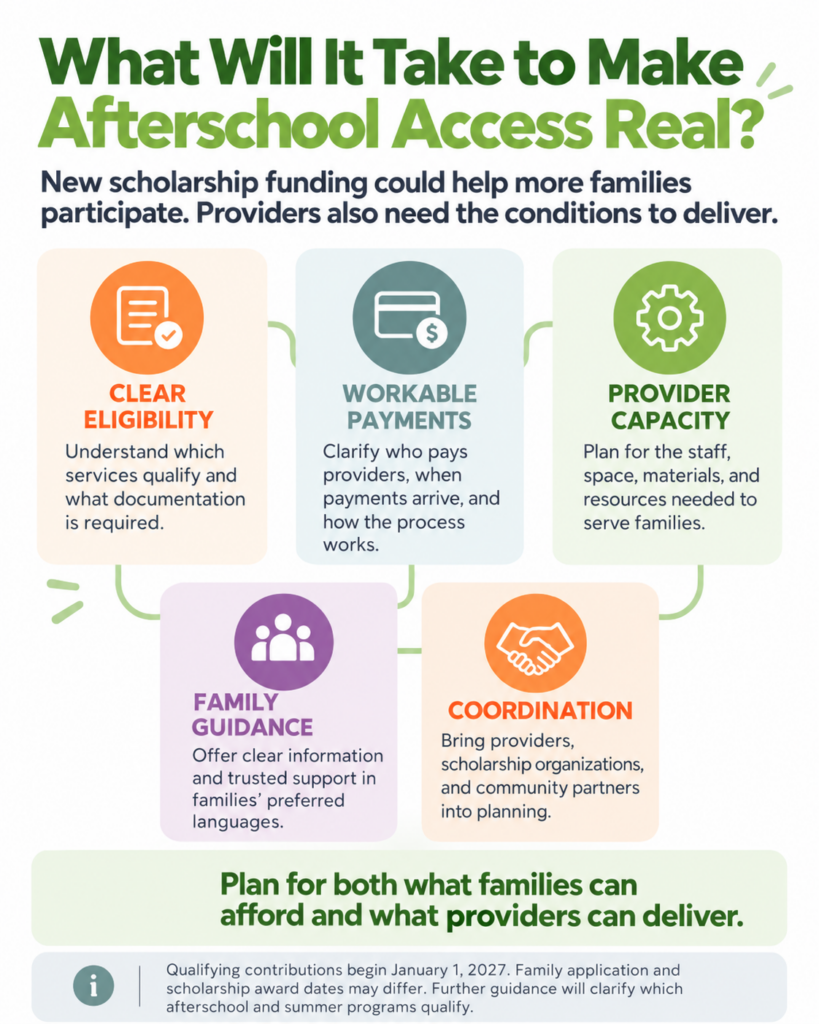
For afterschool providers, preparing for this opportunity means understanding participation requirements, how payments will work, and whether they have capacity to serve additional families. Working through those questions now can help turn new scholarship funding into dependable learning opportunities.
What Our Work With Families Shows
In Jefferson County, RESCHOOL’s partnership with the Edgewater Collective offered a concrete example. 17 families and 40 young people received $20,000 in Learning Dollars. Families used funds for activities and participation costs, including fees, uniforms, equipment, and transportation. One parent who had planned to withdraw their child from a sport was able to re-enroll them. In two cases, additional funding was still needed to cover participation costs.
Additionally, six organizations received $30,000 in Provider Dollar grants, with grant-funded programs reaching more than 700 people. The two funding approaches served complementary purposes: Learning Dollars helped families cover participation costs, while Provider Dollar grants supported organizations that expanded access to their programs. For future tax credit scholarship implementation, the lesson is to plan for both what families can afford and what providers can deliver.
What the New Rules Mean for Afterschool
According to the IRS announcement, qualifying contributions begin on January 1, 2027. Colorado has made an advance election to participate, as shown on the IRS state-status page. That contribution date does not establish when families can apply for or receive scholarships. On October 2, Treasury and the IRS published the proposed rule and temporary procedures for implementation. Further guidance is expected to clarify qualified expenses and what counts as a school, leaving important questions about which out-of-school learning experiences will qualify.
The Afterschool Alliance’s October 5 analysis highlights unresolved questions about community-based and summer programs. It also explains that eligible providers may receive payments from scholarship-granting organizations (SGOs) as vendors, rather than becoming SGOs themselves. For providers and families, the questions are immediate: Which services will be covered? What documentation will be needed? Who will pay the provider, and when? Clear answers will help organizations plan and families understand their options.
Providers Need Clarity, Capacity, and Coordination
Providers are preparing amid financial uncertainty. In the Afterschool Alliance and Edge Research’s Wave 12 survey, conducted in late 2025, 88% of 1,005 respondents reported concern about long-term funding and their program’s future, and 48% reported a waitlist. These national findings show why affordability and available places need attention together. A scholarship can help a family pay, but providers also need the people, space, and resources to welcome additional young people.
For implementation, that means working through practical questions together: clear eligibility guidance, manageable paperwork, payment arrangements that fit providers’ cash flow, and information families can understand and use in their preferred language. Providers and community partners can help identify where those processes might break down before families have to navigate them.
How the Learn Everywhere Fund Builds on This Work
RESCHOOL’s 2025 Impact Report documents more than $1 million raised and reinvested in communities from 2013 through 2025, including approximately $700,000 in Learning Dollars, $235,000 in provider grants, and $130,000 in learner advocate support. That experience informs our approach: funding, community relationships, and navigation each have a role in helping families access learning.
The Learn Everywhere Fund is currently in development and will officially launch soon. This new fund will operate in partnership with RESCHOOL as a dedicated scholarship-granting organization, focused on expanding access to out-of-school-time learning for low- and moderate-income Colorado families, including families whose children attend public schools.
The Fund brings three commitments to this work: reaching public school families, prioritizing communities facing the greatest barriers, and pairing scholarship dollars with trusted, community-based guidance. Its focus is on helping families pursue learning that reflects their children’s interests and needs. Specific scholarship uses will depend on applicable eligibility rules and expense guidance from the IRS.
Build the Conditions Before the Money Moves
The opportunity ahead is to design implementation around the people who will use it. Providers can identify what it takes to deliver dependable programs. Families can help explain what makes an application understandable, guidance useful, and participation possible. Scholarship organizations and community partners can use those perspectives to connect funding with everyday needs.
Preparing for launch means resolving eligibility questions, establishing workable payment processes, and helping providers plan for participation. Follow RESCHOOL’s updates as the Learn Everywhere Fund prepares to launch.